| Lee Tracy |
WORLDRIVERS PROJECT 2004-2012
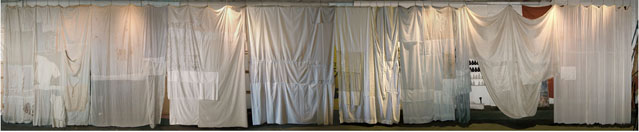
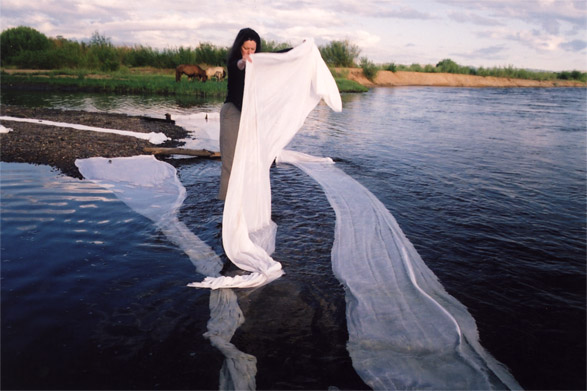
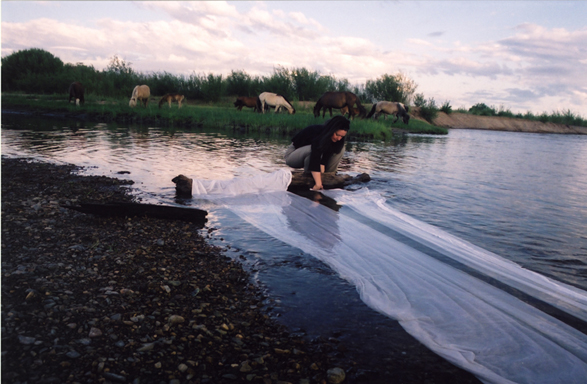
World Rivers is a global collaboration uniting people through the element of water. Individuals from around the world dip white fabric in selected rivers. The fabric pieces are embroidered with the name of the river, location and date and then sewn together into a magnificent curtain. International participants, like rivers flowing to the ocean, join together to form a larger whole. World Rivers reveals a story of water, through the personal experience of many. World Rivers reveals civilization's connection to water while documenting our time in history.
To be part in the World Rivers project
1. Email your location and the name of the river.
2. Find white fabric of any size. See below examples of fabric type, style, and size.
3. Dip cloth in selected river and document with photos.
4. Send dry fabric to: World Rivers, 411 North Wolcott Avenue, Chicago, IL 60622
5. Send or email photos and personal expressions for the project log.
PDF - Printable World Rivers flyer (includes check list and mailing label.)
The World Rivers Curtain is now 120 feet in length with a current goal of reaching 200 feet.
The World Rivers Curtain (whole or in sections) will eventually travel to cultural centers and to locations where attention to a statement concerning water is needed. The project will continue to meet new goals.
White fabric of any type:
cotton, rayon, silk, synthetic, lace, textured, subtle prints and applique, such as the sparkles from India.
White fabric of any style:
pieces or items such as towels, aprons, clothing, pillows, or napkins. Water and sediment stains are fine.
White fabric of any size:
allowing enough space (hand size) to include embroidery of river name, location and date by Alice Van Housen.
Travel the world in your pajamas *** Imagine having different feet *** Wonder about our planet's water *** will the fluid leave in a heat? *** will liquid grow with melted snow? *** will fresh water turn to salt? *** will rivers fill with all we toss? *** who owns this clear flowing stuff? *** Watch little lights on a map increase *** Learn what we come to know *** A litmus test held by many - the gathering of sacred cloth.
How will this project go? How has it gone so far? The first question cannot be answered at this time. Yet, I have resolved within myself the desire to have World Rivers be a beautiful project; a litmus test of our rivers and of our world. There is a light side to human nature and there is a heavy side. I have run into both. In the past four years within the confines of this project, I have had hurt feelings and elated joy, confusion and clarity. I am not one to think these experiences will end. I am one, however, to continue to try and capture our evolution in the brief window of time that World Rivers allows, with a good amount of hope. It is my hope that, when the project is completed and a curtain is created (be it, 2010, 2012, 2015) we will witness proof that the worst extremes of our human nature have weakened, creating a balance that assists in our survival.
What have I witnessed so far? I am witnessing our world, the space we occupy, growing small. Through population growth and inventions of mobility many of us feel cramped, yet, these feelings (that are frustrated by the lack of a solution) often go unheard. The world is shrinking due to our trampling; human decadency stresses our resources at a rate that makes us question whether human dignity can withstand it.
"The more people there are, the less one individual matters." -Isaac Asimov
World Rivers is about individuals.
I am witnessing time speeding up. Our inventions keep us busy with convenience and rapid connection, yet the abundance of information could become problematic. The world is now riddled with intense activity, visible and hidden. The dramatic impact of human's most influential inventions has systematically increased with time and we now find ourselves in a narrowing passage.
| Date | 11600 BC | 3500 BC | 331 BC | 313 AD | 1000 AD | 1900 AD | 1950 AD | 1975 AD | 2000 AD |
| Years Ago | 10,000 | 5000 | 2400 | 1700 | 1000 | 100 | 50 | 25 | 5 |
| Invention | Agriculture |
Writing Cities Trade |
Math Science Libraries |
Spread of Religions |
Monastic Copying Translating |
Industrial Revolution Aero- nautics |
Atomic weapons Astro- physics |
Computer Internet |
Satellites |
| Population | 100,000? | 500,000? | 5 million | 10 million | 200 million | 1 billion | 2 billion | 4 Billion | 6 Billion |
| Climate | Ice melts |
Global flooding |
Global cooling |
Climate recorded |
Enviro. harm noticed |
Climate change discussed |
Climate change confirmed |
The chart is simplified out of the essential need to ask the sweeping and general questions, where are we now? Where are we headed?

A. Do we live in a time where practices and traditions converge, exhausting the energy of our sustaining resources? Like the tail of a mammal, it just ends?
B. Do we live in a time of transition; a time between two stages? Is the nature of life a continuing process of decline (dark ages) and advancement (golden ages?)?
C. Do we exist in a time of dualities, a fall and rise at once? Like two superimposed cones that spiral together as complementary opposites. World Rivers records this quickening of time in an increasingly small amount of space, this time of dramatic change.
I include a brief portion of a larger pattern, that of the geological history of the earth. I am interested in this topic in connection to water, a natural resource that many predict will be fought over, just as oil is today. I wonder if the earth has its own larger seasons that civilization cannot record? Do we find ourselves between a winter or spring that is ending and spring or summer beginning? I am not excluding the impact of humans when asking these questions. I bring it up to make mention of natural patterns, all of which we are part of. Will we adapt to the sudden and increasing changes in our environment, evolving further? Regardless, there are prevalent issues arising due to many of our current habits that are increasingly more easily seen as being primitive. Both discussion and action are needed to address issues of population, food, water and the preservation of the natural resources that sustain our life.
World Rivers will present a unique outlook on the provision of water, our attitude towards it and the changes it is undergoing.
Religions of the world, philosophers, scientists, and artists, past and present, try to explain our condition. I have reverence for all the systems of belief that have sprouted over time driven by specific needs and by curiosity. I am curious. At present, we find ourselves with scientific fields, like theoretical and analytical physics, that attempt to explain both a large picture (black holes, worm holes, negative energy and matter) and small view (the 'quanta' of atoms, nuclei, that now incorporate super string theory and DNA) at once. Two views, one small and one large, that has yet to merge to describe all things in a unified way.
World Rivers is about this pivotal time in history; the colliding of our past (old information re-examined) with recent inventions that present new ways of "seeing". The collision of views, big and small, is being presented. Re-evaluation and change is a given. New decisions will need to be made. People may be faced with the uncomfortable task of letting go of preconceived notions, a process that requires individual thought.
Why is the individual important?
When reviewing history's true advancements, at the root is an individual's idea. Ideas that took great amounts of energy and time (many failures before success) to offer a new perspective to be built upon. I don't make reference to the individual as an infatuation with the importance of ego, the decadency of entertainment, or the pervasiveness of competitiveness. Rather, I refer to individual will, determination and thought. We have learned that when individuals are pushed into labeled groups we witness problems. Today, labeling vast groups is easy, perhaps simpler for our minds to manage, but it must be resisted.
In today's climate, we must acknowledge, there is an emergence of a new form of individual. Evidence is surfacing from the undertow, below the surface of agitation, where busyness exists in muffled silence. It is an arena where a person's ego does not need boosting, the attention of an audience is not sought, a statement of purpose is not needed, and awards of validation do not hold worth. There is a genuine connection of people the world over that are thinking on their own, creating solutions to these pressing problems.
World Rivers crosses dividing lines of regions, occupations, languages and beliefs through the participation of individuals. The strength of World Rivers is the individual expression found within the project's theme of water. As our future unfolds, we can learn what issues arise. There is no expectation, but to respond with thoughtfulness to what is submitted over the years.
Waltie/Morguefile
Fabric remnants, Lee Tracy
Romeo Koitmae/Morguefile
Donny Harder Jr./Morguefile
Missouri River /Historic photo
Gracey Stinson/Morguefile
Yangtze/Historylink101.com
Betsy Damon/Cgee.com
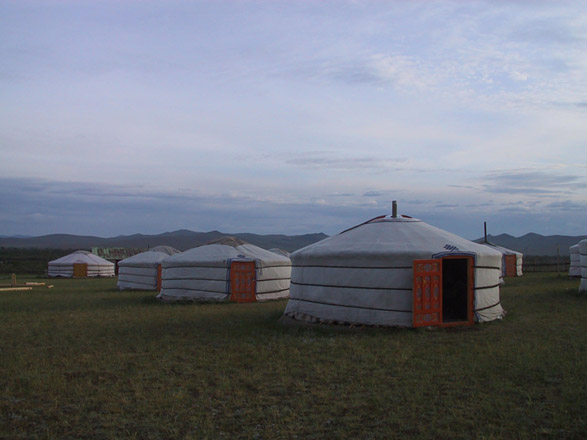
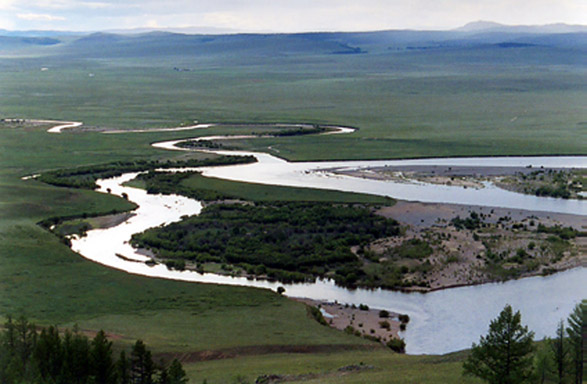
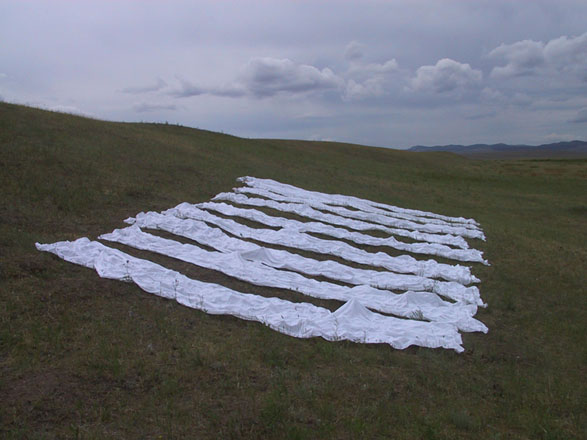
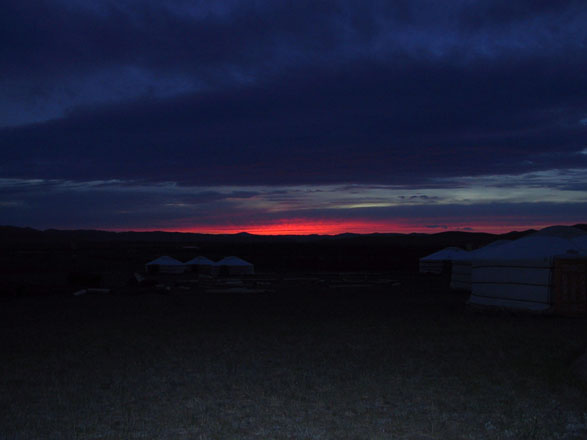
Mongolia, Lee Tracy
Gers, Mongolia, Patricia Evans
Studio, Lee Tracy
Chaminda Gamage, performance
Robii's "Affection of River"
River blessings / unknown
Lee Tracy's "River sketch"
Sandra Joran's "Mandala"
Karina Bergman by Tiffany Teske
"Usha" Stanka Tsonkova
Keith Richardson/Morguefile
Mongolia, Tracey Lauritzen
IN BRIEF
World Rivers is the process of many rivers, and people, coming together. Conceived in 2002, World Rivers is the third of five projects that reference natural elements: Red Trees, 100 Tears, World Rivers, Fleeting Flock and a fifth yet-to-be-named project. Each project involves creating objects altered by nature that, when housed together, become the contents of "The Element Fane", a time capsule, about our environment.
In an effort to stimulate dialogue about water, the vision of World Rivers is to create a magnificent "curtain" made from pieces of white fabric that have been dipped in rivers from all over the world. The process, thus far, has been one of shedding various layers (ideas), letting go, and moving forward. What remains is a patient journey with a general direction that will reveal it's meaning over time as I guide it to completion over many years.
This web site is a place to come together to consider water, water use practices, and the times in which we live. I encourage you to participate and to share in the experience of World Rivers. You are invited to take part in this process of discovery.
MORE...
In research, one finds out quickly that in the last 100 years we have done great damage to our planet. My interest in water developed after reading "Earth Odyssey" by Mark Hertsgaard, who describes the condition of (the world's) water in detail. Water carries warnings of human and animal waste, pesticides, fertilizers, industrial run off and acid rain. Camping in the mountains as a boy, my husband drank directly from rivers by dipping a mug in the running water. It disturbs me that I missed my chance to gather water as it flowed over a mossy rock and into my cup. Sadly, that time has passed for many of us. I was concerned by this reality and took an interest in water.
World Rivers originated in the fall of 2002 while working on another project, Red Trees, Phase 3. Public declarations are fuel to ignite my own action, so one evening I announced to a group of friends that I was embarking on a new project about water where white fabric would be soaked in rivers from all over the world. I honor the importance of these impulses, hidden truths that, if not brought into the open, may disappear. By announcing the idea I increase the chance for its existence. The logistics would come later.
The first step was to test assorted fabric in the Chicago River. A friend, Erik, involved with 'Friends of the River', offered to test fabric while taking trips on the Chicago river. On each voyage the fabric, enclosed in a mesh bag, hung off the side of Erik's canoe and into the water. When the swatches were returned the white polyester, satin, chiffon, silk, and cotton were gray. We talked about how harmful the river water can be and how, if you had a cut, it would be unwise to let the water touch it. This reminded me of two poems that my mother read to me when I was young:
Mother, may I go out to swim?
Yes, my darling daughter
Hang your clothes on the hickory limb,
but, don't go near the water.
The other:
If all the world were apple pie
And all the sea were ink.
And all the trees were bread and cheese
What would we have to drink?
Both poems ask questions. The first laced with denial and contains permission and restriction in a single stanza. The second poem acknowledges a problem as a view of speculation. Each rings true for the environmental harm we are causing today but don't always admit. Two books, "Blue Gold" by Maude Barlow and Tony Clarke, and "Water Wars" by Diane Raines Ward led me to acknowledge the severity of the problem. To draw attention to my concern, I would soak fabric as a litmus test.
I began making a list of obvious rivers; the Amazon, Ganges, Congo, and the Nile. The Yangtze river was in the news and I wanted to get there before it stopped flowing and all the valleys were lost. The potential for travel was investigated. Inquiries where made to The Chicago Cultural Center and the Sister Cities program, the Chinese Consulate, the Zhou Brothers and their foundation. Not everyone understood completely, yet, many sensed my passion. A few saw my aim as unrealistic considering my livelihood and lack of funds.
I received confirmations in many forms. One positive sign came when I discovered a web site of an American environmental artist residing in China, Betsy Damon. She had learned about the legend of a Chinese warrior who tool silk down the Chengdu River. In a community project, Damon had children reenact the legend. I love moments like this, where an idea is enmeshed in the world of another time or place, so similar, yet different. I felt a connection to this ancient hero, one that I am certain trusted intuition as I do. Wanting to learn more about this legend, why the warrior did such a thing, I searched for information and found none. I felt that to receive answers I should continue forward to realize my idea, which I then named; World Rivers.
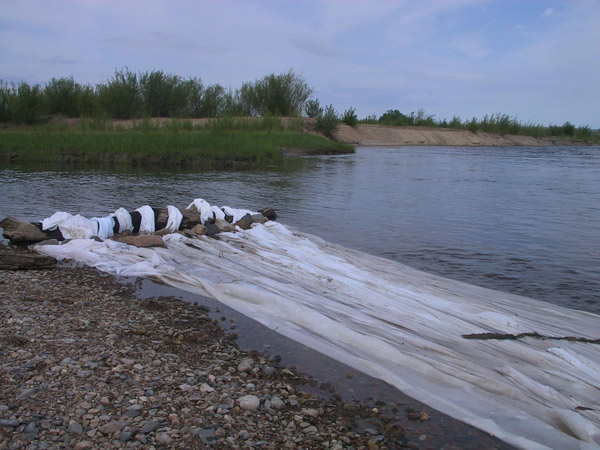
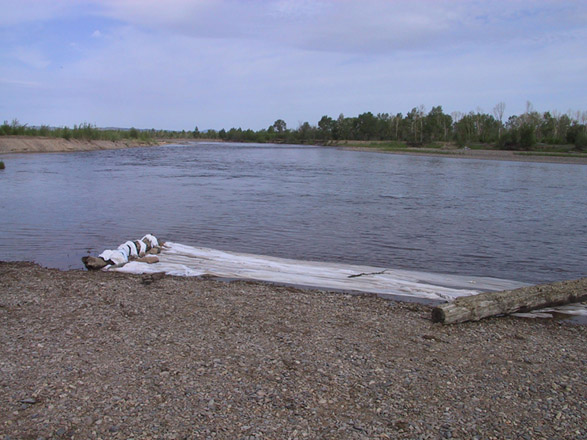
Traveling holds a sense of sacrifice for me, both in personal effort and the impact on our environment. A unique combination gave me the sense that traveling to Mongolia was the place to start. A distant relative in the Peace Corp. provided a sense of trust and integrity. I raised a portion of the funds, took further risks and made it to Mongolia with photographer Patricia Evans. We camped in "gers" on the Onon river, Chingis Khan territory near the Siberian boarder. Being on a relatively unknown river allowed me embrace all rivers, not just the grand ones. I bought white fabric at the market (along with beautiful buttons and horse hair braids to incorporate in the curtain), soaked it in the river and then dried it on the camp fence, a wonderful site. Despite the peaceful experience by the Onon I faced the loss of purity as the pristine white fabric became worn. This became a metaphor for the experience as I let go of an ideal; a certain reality of our world seen, admitted and accepted. On this trip I read "The Cost of Living" by Arundhati Roy, a touching book that reveals the greed of some. >
In Beijing, Patricia and I were met by Johanna, a very dear friend of mine and generous host. We talked about the rivers of China and about the idea that people connected to specific rivers should be involved, as opposed to me intruding. This was my first recognition that the assistance from others was necessary. It wasn?t that I needed to travel to these rivers, I needed the material that holds the energy of them. World Rivers would need to open up to include others in order to grow. How would I find willing participants? Will enough people be moved to get involved?
Once home, I pinned all the fabric to my studio wall: an amazing flowing curtain. I felt certain this is what I was to do.
Upon returning, Chaminda, an artist in Sir Lanka who had introduced himself in several emails prior to my departure, wrote that he could dip fabric in his country. Chaminda was helpful in contacting artists that he had met at art camp in Nepal and several that he had found on the internet. Karina from Canada started World Rivers without question, responding with great spirit. Sandra, a mandala artist in Australia, was immediately interested in the environmental and spiritual aspects. At one point I wondered if this art was a women's project, as they, in this instant, reacted so readily.
World Rivers turned and twisted, changed and grew. Guidelines became necessary in order to solicit and organize artists. At one point, the concept narrowed to a selection of one artist per country with each of us contributing the same amount of fabric. This proved unfair. The large amounts of fabric were attainable to some, but, to others it was a huge expense. I let go of the uniform size, yet, wondered how large the curtain could be if participants were limited. I imagine the curtain as spectacular and powerful; a large room draped in river fabric where one is engulfed by the strength of it. Robii, an artist in Bangladesh, wrote that he was understanding of process and open to allowing the project to become.
I began using the internet to find more artists. Artists would join and then decide not to, a few said no instantly, some were confused. I became aware of my "Americanness", even though my upbringing was one that kept me apart from "American" activity. (I was raised in a sect that didn't celebrate holidays, salute the flag, vote or join in war) Also, a friend mentioned that the government was most likely reading my emails since I was actively emailing abroad. I thought it untrue, but, today I wonder.
Usha in Bulgaria writes lovely emails of the beauty of water. The positive views were welcomed. I became aware of my own focus on the abuses of water and accepted the broadening of the dialogue. While researching I came across a beautiful river ceremony of a man tossing fabric into a river as a form of reverence. Water is filled with opposites, life valuing and life altering. The tsunami then hit. Many river artists were effected; ideas about water deepened.
As I added the participating artists to my personal web site, two issues arose, a need to include personal art in the project and a venue to exhibit that art. I introduced a "cultural curtain", another layer that could be decorated by each artist. Wanting to give contributing artists an opportunity, I investigated the possibility of a professional exhibit. A few leads appeared. Admittedly, I almost lost my way within the scope of the endeavor. World Rivers had to be deconstructed and put back together to become clearer and more manageable.
One curator, Hamza, saw World Rivers as a distinct web-based project. He was also curious to learn why I am doing such a thing, just as I was interested to learn the reasons of the Chinese warrior's voyage. In time, reasoning will become clear enough for expression. The curtain, in this early stage, hangs in my studio and is revealed online.
The template of my personal web site couldn't hold the growth of World Rivers and the need for a separate site was apparent. I bought the domain names and designed the organization of information as I waited for needed funds. This wait is precisely the reason my projects don't have deadlines. I am fine with projects that take years, like life. It keeps me calm.
Sandra's fabric was the first to arrive from Australia! Though, the "cultural curtain" idea waned, Sandra was inspired by the notion of it and sewed a white mandala into the cloth. She shows a sensitivity to the goal of the project while incorporating her own art. Karina has been working on her personal concept as well, deciding that one fabric would embrace the corners of Canada, south, east, west and north. This variety of individual concepts within World Rivers needed to be organized and conveyed on the new website.
A non-artist contacted me to ask if they could contribute. I said, "thanks, but, artists only". It was a low feeling for me to turn someone away. It kept me up at night. I knew I couldn't exclude those that wanted to join in. Immediately, I changed this guideline to include everyone, doctors, students, mothers, teachers, and scientists; anyone touched by the issues of water and a sense of adventure. Things are tried, improvements made. All are now welcome.
Usha, busy organizing her own creative projects, wondered if she could take on another. I told her "no rush", respecting her devotion to her own intentions. Usha emailed me some of her new photographs, one was of white clothing that looked wet. She told me that it was her white work suit. I would welcome clothing such as this, dipped in a river, into the curtain. I had already let go of the size of fabric and now its shape.
I was anxious for more fabric from a river. A friend, De, lives in Chicago and was traveling to London in the summer of 2005. De said that she would be able to dip some white fabric in the Thames on her travels. Next, my friend Sherry visited her girlfriend, Alicia, in Spain and also volunteered to participate. Embracing those traveling to rivers gave way to new expansion. The 21st century world, where extensive movement exists as in no other time, allows me to include travelers and remove a restriction. World Rivers, at this early stage, makes apparent how interconnected we all are. Although individuals have unique customs, backgrounds and beliefs, specific regions do not contain us. I let go some more! All are truly welcome.
World Rivers has settled in place, running at a natural pace. The only remaining guideline is that the fabric must be white and must be dipped in a river. My job is to gently guide the work so it can evolve. My job is to present our shared experience of water. The photographs are beautiful. Separately, they express individual personality, a time in the life of another. As a group, they weave us together. The fabric arriving feels special. It contains the energy of the water, the river, and the person that took the time to join in this contemporary global performance. I have learned that people have enjoyed themselves within the mystery of it all, the very process of art.
It is now 2006, four patient years after I announced the idea. I am so happy that there is a web site where we can participate and watch the process unfold. World Rivers is free to grow and flow like water. I learned to let go. The type of fabric, the size of the fabric, where and when and who holds the fabric is open. It is time to watch and discover the meaning.
The answer is like a river, long and sometimes silent.